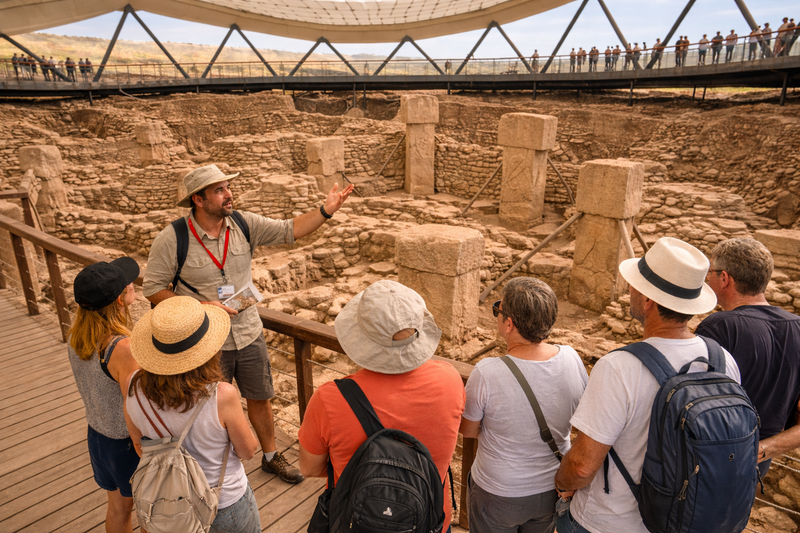
Göbekli Tepe & Sanliurfa City Tour 2 Days 1 Night
€890.00


Known as the City of Prophets, Şanlıurfa pairs sacred fish pools and lively bazaars with Harran, outstanding mosaics and easy access to Göbekli Tepe.
See ToursŞanlıurfa, simply Urfa to locals, sits on the northern edge of Mesopotamia and ranks among southeastern Türkiye's most atmospheric cities. Tradition holds that the prophet Abraham was thrown into a fire here, which turned to water while the burning logs became fish, and the carp at Balıklıgöl are still treated as sacred. Just outside town lies Göbekli Tepe, one of the oldest monumental sites ever found, while nearby Harran recalls a renowned medieval center of learning. Stone alleys, coppersmiths at work, the smell of isot pepper and late-night sıra gatherings make Urfa feel lived-in rather than preserved.
A typical Şanlıurfa trip starts on foot in the old center, where Balıklıgöl, the Mevlid-i Halil cave, the citadel and the covered bazaar with its Ottoman-era Gümrük Han sit close together. Day two is usually a guided trip to Göbekli Tepe and Harran, and many travelers add a boat ride on the Euphrates at Halfeti. Save at least half a day for the Archaeology Museum and the neighboring Haleplibahçe Mosaic Museum. Two or three days lets you see Urfa without rushing. TurTalebi lets you compare Şanlıurfa tours from local firms side by side and book them securely by card.
Tours run by local firms in the area. Pick a date, see the price and book securely by card.
Sacred carp crowd the pools at the heart of the old city, framed by mosques, a madrasa and shady parkland. Join locals for an evening stroll and toss the fish a handful of the feed sold nearby.
Rising on a rocky hill above Balıklıgöl, the citadel is crowned by two ancient columns that locals call the Throne of Nimrod. Its silhouette above the pools is one of the city's defining views.
Wander the covered bazaar, bedesten and coppersmiths' lanes for isot pepper, textiles and hand-hammered copper. Then sit in the courtyard of the Ottoman-era Gümrük Han for tea or a tiny cup of bitter mırra coffee.
About 45 km southeast of the city, Harran's cone-roofed mud-brick houses stand near the ruins of its Great Mosque and medieval university. The flat plain glows at sunset, making late afternoon a lovely time to visit.
One of Türkiye's largest museums, the Şanlıurfa Archaeology Museum showcases the Urfa Man statue and Neolithic finds. Next door, the Haleplibahçe Mosaic Museum displays superb ancient mosaics, including the Amazon queens, right where they were discovered.
Venerated by tradition as the birthplace of the prophet Abraham, this cave just steps from Balıklıgöl is an active place of pilgrimage. Keep your voice low and dress modestly when you visit.
April and May are lovely, with warm days and a green Harran plain, and October and November bring pleasant weather once the summer heat breaks. From June to September temperatures frequently pass 40°C (104°F), so sightsee early and late and spend midday in museums or shady courtyards. Winters are mild but often rainy, with far fewer visitors. During Ramadan and the religious holidays, Balıklıgöl fills with domestic pilgrims and families, which is lively but busy.
Şanlıurfa GAP Airport has regular domestic flights from İstanbul and Ankara, and the drive into the city takes about half an hour. By road, Gaziantep is about two hours away and Mardin about two and a half. The old center is easily walkable, but for Harran, Göbekli Tepe and Halfeti a tour vehicle or rental car is the practical choice. The Gaziantep, Şanlıurfa and Mardin loop is the classic first trip to southeastern Türkiye.